


Imagine the phone is wrong.
You are about to send a meaningful balance. The address or contract shown by the app is not the action the host is actually preparing. The private key is still inside the hardware wallet. The problem is no longer key theft; it is whether the signer gives you an independent way to catch a bad instruction before the signature exists.
That is the cleanest way to compare Tangem with Ledger Flex.
Affiliate disclosure: The Tangem and Ledger links in this comparison are tracked. Cryptophia Research may earn a commission from a qualifying purchase at no extra cost to you. The conclusion is based on the signing and recovery models below. See our Affiliate Disclosure and How We Research.
One transaction, two approval paths
| Step | Tangem | Ledger Flex |
|---|---|---|
| Transaction is constructed | Phone/app prepares it | Phone/computer app prepares it |
| Private key lives | Inside the NFC card | Inside the Secure Element |
| What the user reads before signing | Primarily the phone screen | Supported details on the secure E Ink touchscreen |
| Approval friction | Tap card to phone | Review and confirm on a separate signer |
| Main verification trade-off | Very low friction, but no independent hardware display | More friction, but a second trusted display exists |
The important distinction is not that one device “has better security.” Both isolate the key from ordinary phone or computer storage. They differ in where the human is expected to understand the transaction.
If the host is compromised, the screen becomes the argument
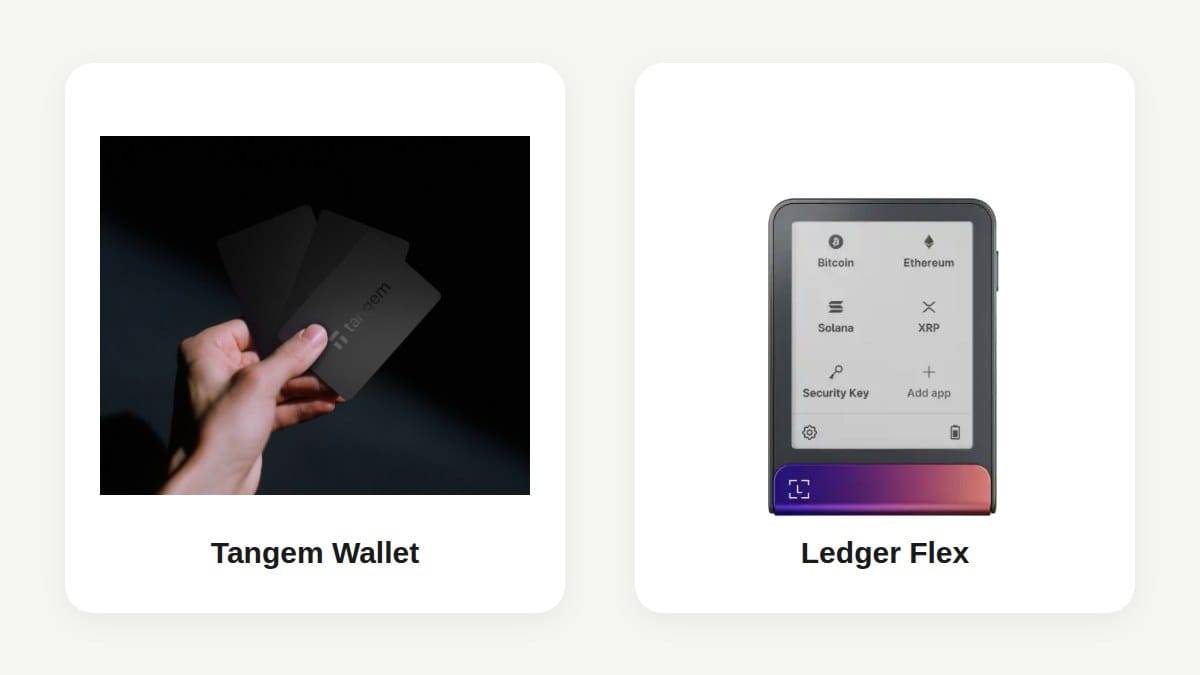
Tangem’s card has no display. The mobile app presents the destination, amount, network and dApp context; the card performs the cryptographic operation over NFC.
That architecture can work well for a narrow job: receive assets, send straightforward transfers, and keep the signing process physically simple. But a compromised host does not need to extract the key if it can misdescribe the action convincingly enough for the owner to approve it.
Ledger Flex inserts a second display into that path. Its secure E Ink touchscreen is driven through Ledger’s secure-device architecture, and supported Clear Signing flows can present human-readable transaction details on the signer itself.
That does not make every smart-contract interaction safe. If a transaction cannot be decoded clearly, the existence of a good screen does not create information that the wallet software does not have. But when the transaction can be rendered accurately, an independent display is a meaningful extra checkpoint.
The same lost-device event produces a different response
Now change the scenario. The wallet is not in your hand.
For Tangem, this matters more after Ledger Donjon’s July 2026 laser fault-injection research. The demonstrated attack requires physical possession, invasive work, specialist equipment and expertise; it is not a remote attack. The researchers nevertheless showed that a capable attacker with one card could reset the access password and move the associated funds.
Tangem disputes the practical scalability of the attack and emphasises the cost, preparation and visible physical damage involved. Both points belong in the risk assessment.
The operational conclusion is narrower than “Tangem is unsafe”: if a Tangem card protecting a material balance is lost or plausibly stolen, a trusted backup should be treated as a route to fresh keys rather than a reason to assume the missing card can be ignored indefinitely.
Ledger Flex creates a different lost-device problem. The device still has to resist physical access, but the wallet’s portable recovery layer is the recovery material rather than another equivalent copy of the same card. The owner therefore needs a tested recovery plan and must still decide when physical loss justifies moving funds.
Firmware makes the two designs age differently
Tangem card firmware is immutable after manufacture. Ledger Flex firmware is updateable.
Those choices reverse the long-term trust problem.
- Tangem: there is no ordinary post-sale firmware-update channel to compromise, but a weakness already shipped cannot receive a conventional firmware patch.
- Ledger Flex: new vulnerabilities or transaction-handling problems can be addressed through signed updates, but the owner continues to trust Ledger’s future update process.
The July 2026 Tangem finding is useful precisely because it makes this trade-off concrete rather than theoretical.
Three users can reach three different answers
The simple mobile holder
If the wallet mostly receives assets and sends straightforward transfers, Tangem’s low-friction NFC workflow can be the better design. Less device management can reduce the chance that self-custody becomes so inconvenient that assets remain on an exchange or hot wallet.
The frequent multi-chain signer
If the wallet signs unfamiliar contracts, approvals or transactions across several networks, Ledger Flex has the stronger case. The independent screen does not remove contract risk, but it gives the owner another place to challenge what the host is asking for.
The high-consequence vault
If one signing mistake or one lost device could create a life-changing loss, neither product should automatically be treated as the entire custody architecture. Separate long-term savings from experimental signing, document recovery, and reduce the number of systems that can authorise the full balance.
What actually decides the comparison
Tangem wins when removing friction is itself a security improvement and the wallet’s job stays simple. Ledger Flex wins when the extra verification surface is worth more than the convenience it costs.
The distinction is not “card versus touchscreen.” It is this:
Tangem asks you to trust the phone to explain the transaction while keeping the key off the phone. Ledger Flex tries to move more of the final explanation onto the signer itself.
That is the failure mode I would choose around.
For the product-level detail behind this comparison, read the Tangem Wallet review, the Ledger Flex review, and the Hardware Wallet Threat Model Matrix.
Current product links: Tangem · Ledger Flex