

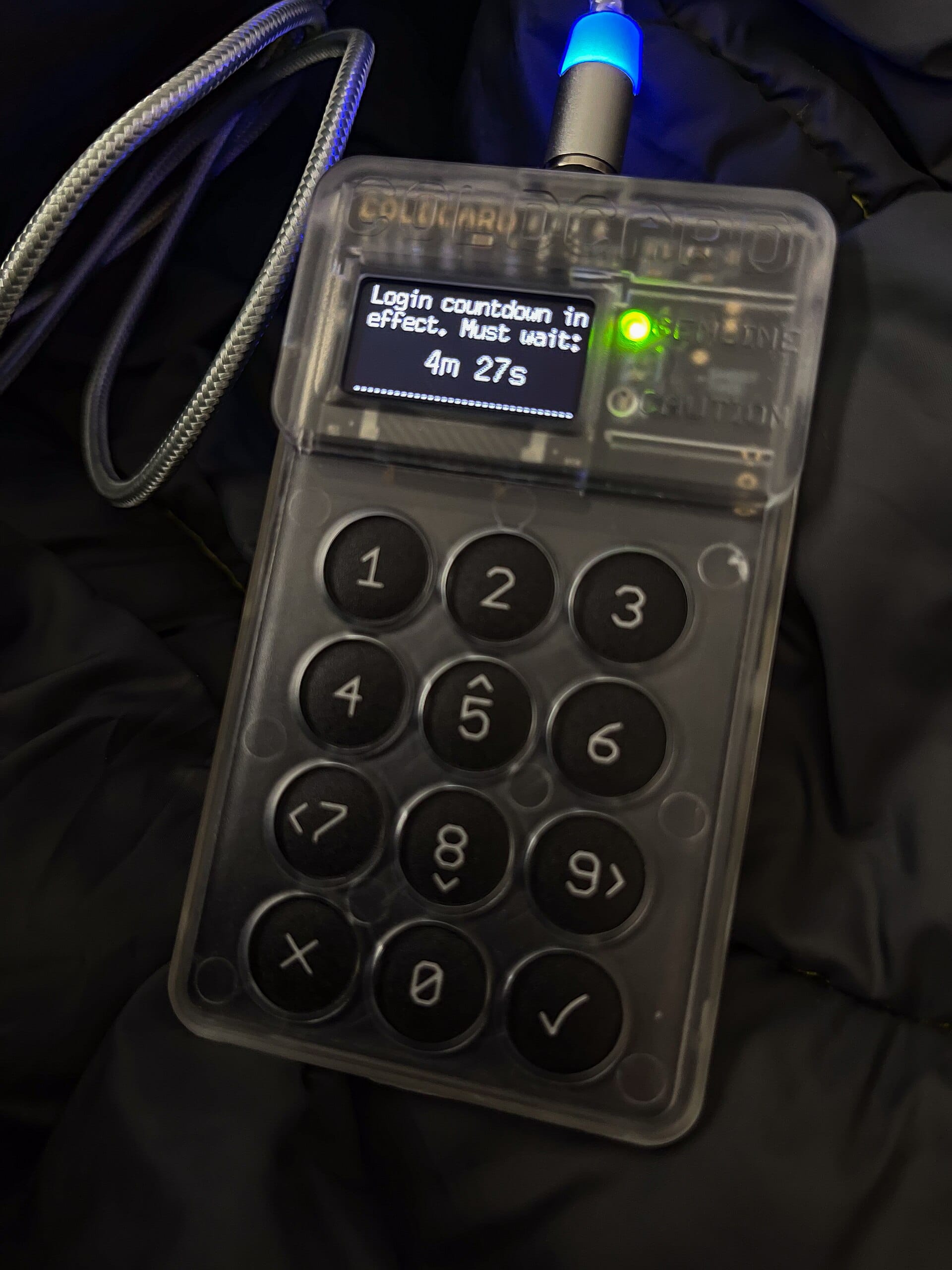
An air-gapped hardware wallet keeps the signing device off the internet and avoids a live data connection to the online phone or computer during normal use. An unsigned transaction crosses to the signer by QR code or removable media; the signature crosses back. The private key stays offline.
Affiliate disclosure: This article contains tracked Keystone and BitBox links. Cryptophia Research may earn a commission from a qualifying purchase at no extra cost to you. Commercial relationships do not determine the conclusion. Read the Affiliate Disclosure and How We Research.
That design can remove USB, Bluetooth and network interfaces from the routine signing path. It cannot make an incorrect transaction safe. The wallet still has to parse data from an untrusted online device, display what it understood and rely on the owner to reject anything wrong.
This is the useful definition: an air gap separates the private key from the network. It does not separate the signer from transaction data.
One Bitcoin transaction crosses the gap twice
Start with a watch-only wallet on an internet-connected computer. It knows the public information needed to show balances and prepare a payment, but it does not hold the private key needed to authorize that payment.
- The online wallet constructs an unsigned transaction.
- It encodes the transaction as a QR sequence or saves it to a MicroSD card.
- The offline hardware wallet imports the data and shows the destination, amount, fee and change it can identify.
- After local approval, the hardware wallet signs with the private key stored inside it.
- The signed transaction returns by QR or file to the online wallet, which broadcasts it to the Bitcoin network.
Bitcoin commonly uses a PSBT—Partially Signed Bitcoin Transaction—for this workflow. BIP 174 defines a portable container for an unsigned transaction plus the metadata that different coordinators and signers may need. The standard improves interoperability. It does not certify that the payment inside the container matches the owner’s intent.
The gain is narrow and important: the online computer can prepare and broadcast a Bitcoin transaction without receiving the private key.
“Air-gapped” does not describe one universal design
Wallet vendors use the term differently. Keystone describes a QR-only transaction path and excludes Bluetooth, Wi-Fi, USB data and NFC from that path. COLDCARD supports MicroSD and QR workflows, while its documentation also calls short-range NFC transfers air-gapped options. A strict networking definition may reject NFC because it is still a live wireless interface.
So do not treat the label as a certification. Ask which interfaces the exact device has, which are enabled during signing, what information can cross each interface and whether the device can operate after optional interfaces are disabled.
An ordinary hardware wallet can also keep private keys offline while using USB or Bluetooth to exchange transaction data. That makes it cold storage without necessarily making it air-gapped. “Cold” describes key exposure; “air-gapped” describes the communication architecture used around the signer.
Three setups are sold under the same air-gapped wallet label
A dedicated hardware signer is the most purpose-built option. Devices such as COLDCARD and Keystone use QR codes, MicroSD or both for offline signing, with their own screens, firmware and key-storage architecture. A secure element can raise resistance to physical extraction, while open-source firmware can improve inspectability; neither feature proves that every transaction will be decoded correctly.
A two-phone setup turns an old smartphone into an offline vault while a second, connected phone runs the watch-only wallet. This can be inexpensive, but “airplane mode” is not the same as a device designed without network hardware. Battery health, operating-system updates, disabled radios and app authenticity become part of the threat model.
An offline general-purpose computer can sign transactions without connecting to the internet. It offers flexibility but also a large operating system, many parsers and more ways for removable media to carry unwanted data. A paper wallet is sometimes grouped with air-gapped cold storage, but safe key generation and spending from paper create a different—and often fragile—workflow.
For most buyers searching for an air-gapped crypto wallet, the useful comparison is therefore not “offline versus online.” It is dedicated signer versus repurposed general-purpose device, followed by a close look at how each one receives updates and transaction data.
The gap removes interfaces, not hostile input
Imagine malware on the online computer replaces the intended destination before creating the unsigned transaction. The QR code is now a faithful encoding of a dishonest payment. The air-gapped wallet has not failed if it displays the attacker’s address. The security decision has moved to the trusted screen and the person reading it.
The same principle applies to a MicroSD card. It is a transport, not a filter. An offline device still contains code that parses PSBT files, QR frames, wallet descriptors and firmware packages. A malformed input can reach that code even when no cable is attached. Air-gapped security therefore depends on narrow parsers, trustworthy firmware, useful on-device warnings and complete transaction verification.
This is why display quality matters more than the visual drama of scanning a QR code. If a signer cannot show the full destination, amount, fee, change and relevant policy—or if a smart-contract interaction is presented as unreadable data—the owner is being asked to approve something the air gap did not explain.
What an air gap can genuinely improve
- Fewer live interfaces. Removing routine USB data, Bluetooth or Wi-Fi reduces the code directly reachable from a connected host.
- Separation of roles. The online wallet constructs and broadcasts; the offline hardware wallet stores keys and signs.
- A visible transaction boundary. QR or file movement makes it harder to forget that untrusted data is entering the signer.
- Coordinator choice. Standard formats such as PSBT can reduce dependence on one vendor’s desktop application.
- Offline key isolation. A compromised computer should not be able to read the private key merely because it prepares a payment.
These are reductions in attack surface. None is a claim of maximum security or immunity from hacking.
Five failures remain on the same side of the gap
A stolen recovery phrase. Anyone with the seed phrase and any required passphrase can rebuild the wallet elsewhere. No transaction needs to cross the original device.
A bad transaction approved on-screen. Address substitution, deceptive change, an excessive fee or an unreadable contract can be signed perfectly.
Malicious or vulnerable firmware. Offline software can still generate weak keys, misrepresent transaction data or leak information through permitted outputs.
Supply-chain substitution. A counterfeit or pre-initialized device can arrive without network interfaces and still be hostile.
Physical loss, coercion and failed recovery. Connectivity design does not decide whether a thief can unlock the device, whether heirs can recover it or whether the owner’s backup is correct.
For those wider attack paths, see Can a Hardware Wallet Be Hacked? Air gapping changes one branch of that threat model; it does not replace the model.
QR and MicroSD create different operational risks
QR signing is camera-based and visually bounded. Animated QR protocols can move larger transactions across many frames, so the signer still needs a decoder and transaction parser. QR is convenient when the device and coordinator support the same format; incompatibility can turn an elegant workflow into repeated manual work.
MicroSD signing handles larger PSBTs, multisig files and firmware updates easily. The card moves between trusted and untrusted devices, however, and it can carry more than the one file the owner intended. Card handling, file selection and safe removal become part of the security process.
USB signing keeps the workflow simpler and can support a narrow, well-tested protocol with on-device confirmation. It exposes a live interface to the host, but that does not automatically make it unsafe. Shift Crypto, the maker of BitBox, argues that the usability and protocol advantages of USB can outweigh the marginal benefit of an air gap. That vendor position is not neutral evidence, but it is a serious engineering counterargument to the idea that QR is always superior.
The transport is a trade-off, not a moral category. The decisive questions are what the signer parses, what the screen reveals and whether the owner will actually verify it.
Who benefits—and who may be buying theatre
An air-gapped hardware wallet fits a Bitcoin holder who transacts rarely, already understands a watch-only coordinator and wants to remove unnecessary live interfaces. QR or MicroSD also fits some multisig setups where several signers exchange standard files deliberately.
It is a weaker fit for someone who signs frequent DeFi transactions, depends on broad multi-chain integrations or finds the extra transfer steps confusing. A more complicated workflow can reduce real security when it encourages blind approval, skipped firmware updates or an untested recovery process.
The same warning applies to NFTs and smart-contract tokens. An air-gapped wallet can store the private key and sign the request, but it cannot make an opaque approval understandable. If the trusted display cannot decode the contract action, the owner is still relying on the connected wallet software.
Before paying more for the label, verify five things:
- The device can display the full transaction details relevant to the assets you use.
- The QR or file format works with a coordinator you trust.
- Optional USB, Bluetooth or NFC interfaces can be disabled if that is part of your threat model.
- Firmware updates have an authenticated, documented process.
- You can complete a small receive, sign, broadcast and recovery test without improvising.
Our hardware-wallet guide by threat model compares the air gap with the other controls that affect the buying decision. If the more basic question is how much belongs behind an offline signer, start with Hot Wallet vs Cold Wallet.
My judgment: an air gap is valuable when it removes interfaces you do not need and makes transaction review more deliberate. It is security theatre when the label substitutes for readable signing, verified firmware, a protected recovery phrase or a workflow the owner can execute correctly. The gap can block a cable. It cannot tell a good transaction from a bad one.
Primary sources and competing engineering views
- BIP 174: Partially Signed Bitcoin Transaction format
- COLDCARD: PSBT transaction review and export methods
- COLDCARD: air-gapped multisig transfer methods
- Keystone: QR transaction input and output design
- Shift Crypto: engineering argument against treating air gaps as automatically safer
Supported transports, transaction formats and firmware behaviour vary by device model and release. Verify the manufacturer’s current documentation for the exact signer you are considering.