


A beginner hardware wallet should survive an ordinary bad week.
The phone is compromised. The signer goes missing. The recovery instructions are being followed under stress. A transaction looks unfamiliar. If the custody design only works when nothing goes wrong, the product is not beginner-friendly no matter how polished the setup screen looks.
That is the standard behind this shortlist.
Affiliate disclosure: Some product links in this guide are tracked affiliate links. Cryptophia Research may earn a commission from a qualifying purchase at no extra cost to you. The ranking is based on the failure modes below, not commission rate. See our Affiliate Disclosure and How We Research.
How this ranking was built: this is a documentation- and architecture-led comparison. It evaluates trusted transaction display, recovery design, firmware model, physical-loss response and product complexity. It does not pretend that specification review is the same as long-term hands-on testing.
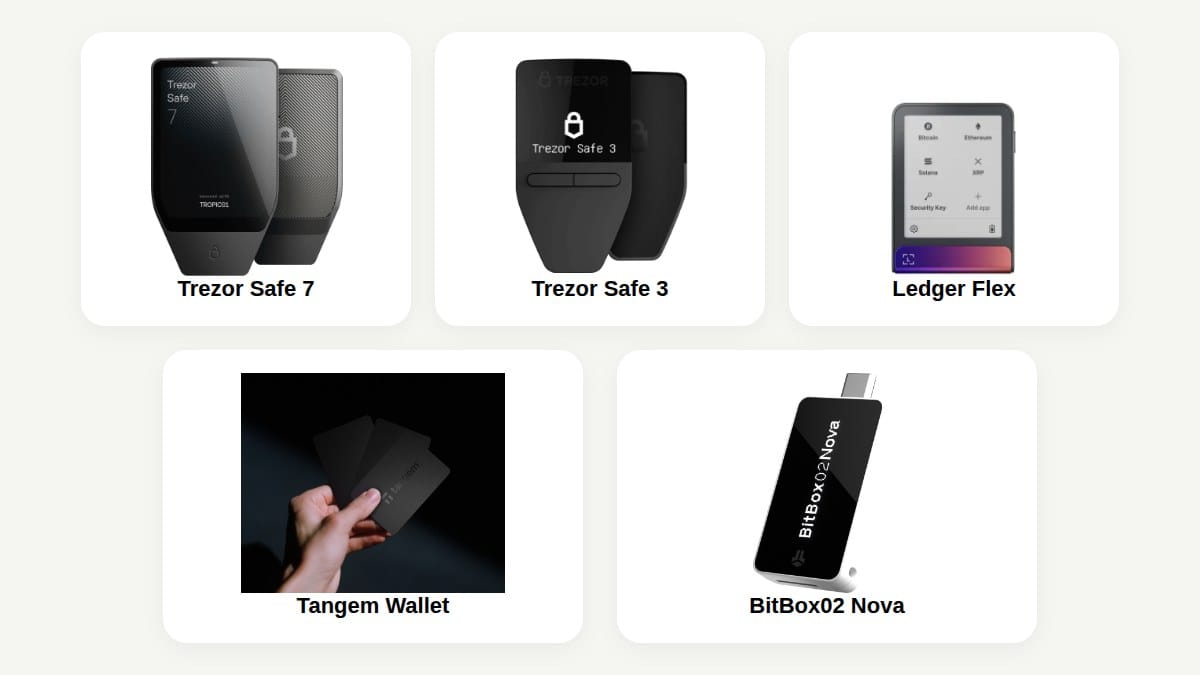
Five wallets, five different failure budgets
| Wallet | The failure it handles especially well | The failure you still have to manage |
|---|---|---|
| Trezor Safe 7 | Readable independent verification plus open firmware and layered hardware | Advanced recovery and a richer device architecture can become more complex than a beginner needs |
| Trezor Safe 3 | Dedicated signing and inspectable firmware at a lower price | Small-screen review is less comfortable for long or complex transactions |
| Ledger Flex | Large secure display for frequent multi-chain signing | Greater reliance on Ledger’s proprietary secure-device software and wider service ecosystem |
| Tangem | Very low setup and daily-use friction | No independent hardware display; a lost card now deserves a more active response after the July 2026 physical attack disclosure |
| BitBox02 Nova | Restrained product surface, open firmware and portable recovery | Smaller display than premium touchscreen devices |
My starting choice for most beginners protecting meaningful long-term holdings is Trezor Safe 7. That is not because it has the longest feature list. It is because the large trusted display, open firmware and layered hardware give a new owner several independent ways to catch mistakes without requiring the wallet to become a complicated project on day one.
The first test: can the device disagree with the phone?
The host phone or computer constructs the transaction. A beginner-friendly signer should make it possible to compare that request with information presented on hardware that is not merely repeating the same compromised screen.
Trezor Safe 7, Trezor Safe 3, Ledger Flex and BitBox02 Nova all provide independent displays. Tangem deliberately chooses a different model: the card isolates the key while the phone remains the visual transaction interface.
That is not a trivial design preference. A compromised host does not need to steal the private key if it can persuade the owner to approve the wrong action. A trusted display creates a second checkpoint; it does not make an opaque smart contract safe, but it can make a simple wrong-address or misdescribed transaction easier to catch.
The second test: does recovery still make sense six months later?
The hardware device is replaceable. The recovery architecture is what has to survive time, stress, relocation and eventually another person.
A beginner should be able to answer, without opening a vendor tutorial:
- what reconstructs the wallet;
- where that recovery material is stored;
- whether a passphrase or multiple shares are involved;
- what happens if the signer disappears;
- how an authorised person would identify the correct recovery route.
More options can improve resilience and also create more ways to fail. Multi-share recovery, passphrases and several backup devices are useful only when they solve a defined threat and remain understandable later.
The third test: what changes when the physical signer is stolen?
This is where product architecture becomes operational rather than theoretical.
Ledger Donjon’s July 2026 research demonstrated a laser fault-injection attack against Tangem cards. The attack requires physical possession, invasive chip work, specialist equipment and expertise; it is not a remote drain. Tangem argues that the method is expensive, difficult to scale and visibly destructive.
Those practical constraints matter. So does the demonstrated result: a capable attacker with one card could reset its access password and move the associated funds.
For a beginner, the useful rule is simple. A lost Tangem card protecting a material balance should trigger a decision, not indefinite reassurance. If a trusted backup remains available and theft is plausible, migrating to fresh keys is a bounded response.
Other signers have different physical-security assumptions, but none turns device loss into a non-event. The point of the test is to know the response before the device is missing.
The fourth test: can the security model absorb new evidence?
Hardware wallets are security software that happens to be physical.
Updateable firmware can fix defects and improve transaction handling, but it extends trust into future signed updates. Immutable firmware removes that update channel, but freezes weaknesses already shipped. Open firmware improves inspectability, but public code is not a proof that every build, dependency or hardware layer is flawless.
A beginner does not need to become a firmware auditor. The owner does need a product whose update and recovery model can be explained clearly enough to act when new evidence appears.
Why Trezor Safe 7 starts first
Trezor Safe 7 combines a 2.5-inch colour touchscreen with open-source firmware and three hardware layers: TROPIC01, an OPTIGA Trust M Secure Element and the STM32U5 microcontroller. It also supports wired and wireless operation and multiple backup formats.
The large display is the most immediately useful feature for a beginner because transaction verification is a behaviour, not a specification. If reading the signer is tedious, users eventually stop reading it.
The June 2026 TROPIC01 disclosure is still material. Ledger Donjon demonstrated invasive fault injection against the chip, including bypass of firmware-signature verification. Trezor’s Safe 7 architecture uses TROPIC01 as one of several independent layers and states that compromising that component alone does not expose the complete wallet.
That lowers confidence in treating one chip as invulnerable. It does not justify pretending the complete Safe 7 wallet was remotely broken. The recommendation survives because the comparison is about the whole custody system, not a certification badge.
The alternatives are different answers, not four runners-up
Trezor Safe 3: spend less without giving up the independent signer
Safe 3 keeps the basic Trezor model—open firmware, Secure Element, USB-C and hardware confirmation—without the larger touchscreen and wireless complexity. The compromise is mostly review comfort. For simple, infrequent transactions, that can be a sensible trade.
Ledger Flex: pay for the verification surface you will actually use
Ledger Flex makes more sense for a beginner who is already a frequent multi-chain user. Its 2.8-inch secure E Ink touchscreen and supported Clear Signing flows can present more transaction context on the signer. The trade-off is a broader trust boundary around Ledger’s proprietary secure operating system and wider app ecosystem.
Tangem: remove enough friction that self-custody actually happens
Tangem’s NFC workflow can solve a real security problem: some people leave assets on exchanges or hot wallets because conventional hardware-wallet routines feel too cumbersome. The price of that simplicity is that transaction intent remains on the phone and seedless recovery depends on surviving hardware copies.
BitBox02 Nova: keep the product surface deliberately narrow
BitBox02 Nova combines open firmware, an EAL6+ secure chip, microSD recovery and support across desktop, Android and iOS. Its smaller display is less comfortable than premium touchscreens, but the overall design remains restrained and easy to reason about.
A first-day drill matters more than another feature comparison
- Buy through an official or clearly authorised source.
- Install wallet software from a verified manufacturer source.
- Generate the wallet yourself; reject pre-filled recovery material.
- Keep recovery material offline and separate from the signer.
- Verify a receive address on the hardware display where one exists.
- Send a small test transaction.
- Prove the documented recovery route works safely.
- Write down what a lost signer would trigger.
- Keep long-term savings away from experimental dApps and broad token approvals.
A wallet that passes the specification comparison but fails this drill is not ready for a meaningful balance.
What would change this ranking?
I would move a wallet materially up or down if new evidence changed one of the failure mechanisms above: a demonstrated device-level compromise, a meaningful recovery redesign, a material change in transaction verification, an unresolved firmware problem, or evidence that a claimed safety layer does not work as described.
Price cuts and longer coin lists matter far less unless they change the job the device can perform safely.
For a deeper threat-model comparison, use the Hardware Wallet Threat Model Matrix and the hardware wallet setup checklist before moving meaningful value.
Current product links: Trezor Safe 7 · Trezor Safe 3 · Ledger Flex · Tangem · BitBox02 Nova
Primary sources
- Trezor Safe 7 product and architecture documentation
- Trezor Safe 3 specifications
- Trezor response to the June 2026 TROPIC01 disclosure
- Ledger Donjon: TROPIC01 laser fault-injection research
- Ledger Flex specifications
- Ledger Clear Signing documentation
- Ledger Donjon: Tangem laser fault-injection research
- Tangem response to the July 2026 finding
- BitBox02 Nova specifications