

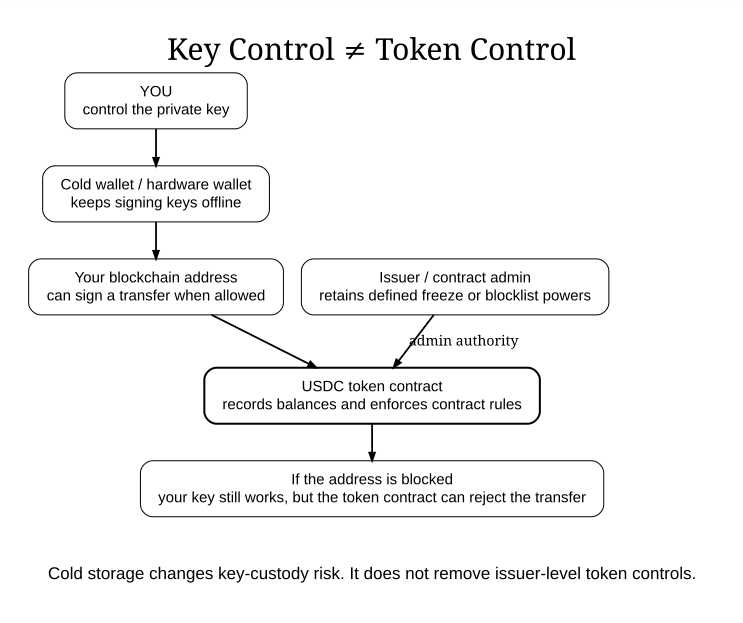
Yes. USDC can be frozen even when it is held in a cold wallet or hardware wallet. Self-custody gives you control of the private key used to sign transactions from your address. It does not remove powers built into the USDC smart contract or legal obligations imposed on its issuer.
Circle’s linked USDC Terms, last updated December 12, 2025, apply to holders outside the European Economic Area (EEA). Circle directs EEA holders to its USDC White Paper, amended July 10, 2026. Both sources describe address-blocking powers and circumstances in which USDC may be frozen, including suspected prohibited activity or a valid legal order. A hardware wallet cannot override that contract-level control.
My judgment: cold storage meaningfully reduces private-key theft and exchange-custody risk. It does not convert an issuer-controlled stablecoin into a censorship-resistant bearer asset. Treat those as separate layers of risk.
The four control layers that matter
The cleanest way to reason about a stablecoin in self-custody is to separate four different control layers. A cold wallet materially changes only one of them.
| Layer | Who or what controls it | What self-custody changes | Failure that remains |
|---|---|---|---|
| Signing authority | Your private key and recovery system | You—not an exchange—authorise transactions | Key theft, lost backup, bad signing decisions |
| Token contract | USDC contract logic and administrative state | Nothing | Blocklisting, pausing or other issuer-administered controls where supported |
| Issuer and redemption | Circle and the applicable regulated entity | Holding is self-custodied; direct redemption eligibility does not automatically change | Compliance restrictions, redemption limits, reserve or issuer risk |
| Legal and network environment | Courts, regulators and the underlying blockchain | Nothing | Valid legal orders, chain outages, congestion or protocol failures |
This is why “not your keys, not your coins” is incomplete when applied to an issuer-controlled token. Keys determine who may request a transfer. They do not necessarily determine whether the asset’s contract and issuer will permit that transfer.
Circle’s current EEA USDC White Paper makes the technical distinction unusually explicit: its EVM-compatible specification includes a blocklisting feature that can prevent specified blockchain addresses from sending and receiving USDC. The same document also describes upgradeable contract architectures on EVM deployments. The exact implementation differs across supported chains, so the relevant contract—not the ticker symbol alone—is the object to verify.
Why a cold wallet does not make USDC unfreezable
A cold wallet protects signing authority. USDC is a token whose transfer rules are enforced by smart contracts on supported blockchains. When you send USDC, two systems matter:
- Your wallet key proves that the address owner authorised the transaction.
- The USDC contract decides whether the token transfer is permitted under its current code and administrative state.
If an address is blocklisted by the relevant USDC contract, possession of the correct private key does not force the contract to process a transfer. The key can still sign a transaction; the network will execute the contract rules and may reject or prevent the token movement.
What “frozen” means
People often combine several different events under the word frozen:
- Exchange account restriction: an exchange prevents withdrawals or trading inside its own account system.
- Wallet access loss: the owner cannot sign because the device, recovery phrase or passphrase is unavailable.
- On-chain token blocklist: a token contract prevents transfers involving a specified address.
- Redemption restriction: the issuer or a regulated intermediary refuses or delays converting tokens into fiat.
- Blockchain disruption: the underlying chain is congested, paused or reorganised.
A cold wallet helps mainly with the second category and reduces dependence on the first. It does not eliminate the third or fourth.
What Circle’s terms say
For holders outside the EEA, Circle’s USDC Terms state that it reserves the right to block transfers to and from certain addresses and may freeze associated USDC in specified circumstances. For EEA holders, Circle’s USDC White Paper likewise states that Circle SAS may block addresses, freeze USDC or comply with a valid government order.
The legal wording and its application can vary by jurisdiction and supported blockchain. This article explains the custody mechanism; it is not legal advice and does not predict whether a particular address will be blocked.
Does Circle need your hardware wallet?
No. An issuer-level freeze does not require physical possession of your Ledger, Trezor, Tangem, OneKey or other signer. It does not require knowledge of your seed phrase or PIN.
The administrative action targets the token contract or the issuer’s redemption relationship, not the secret stored in the device. The hardware wallet may remain fully functional for Bitcoin, Ether and unrelated tokens while the affected USDC balance cannot move.
Can Circle take other assets from the wallet?
Blocking USDC does not give Circle the private key and does not automatically grant control over Bitcoin, native Ether or unrelated tokens in the same address. Each asset follows its own protocol and contract rules.
However, using one address for many assets creates operational and privacy links. If an address becomes the subject of compliance action, other service providers may also review transactions involving it. Separating long-term savings, stablecoin settlement and dApp activity can make risk easier to contain and explain.
Cold wallet vs exchange for holding USDC
| Risk | USDC on an exchange | USDC in self-custody |
|---|---|---|
| Exchange insolvency | Direct exposure | Reduced after withdrawal |
| Account restriction | Exchange can restrict access | No exchange login is needed to sign |
| Private-key theft | Exchange controls keys | Owner must secure keys and backup |
| USDC blocklist risk | Still present, plus platform controls | Still present at token-contract level |
| Direct Circle redemption | Depends on platform and account | Holding a token does not automatically create a Circle Mint account |
| Recovery support | Account-based process may exist | Lost keys may be unrecoverable |
Moving USDC off an exchange removes one counterparty layer. It does not remove Circle, the reserves, the supported blockchain, the token contract or the recipient’s compliance exposure.
Can USDT or other stablecoins also be frozen?
Many centralised stablecoins retain administrative controls, but the exact powers and procedures differ. Do not assume that every dollar token has the same contract, issuer, jurisdiction, reserves or blocklisting policy.
Decentralised or crypto-collateralised stablecoins introduce different risks: liquidation, oracle failure, governance capture, collateral depeg and smart-contract failure. “Cannot be frozen by one issuer” is not equivalent to “cannot fail.”
Can wrapped or bridged USDC be frozen?
The answer depends on the exact asset. Native USDC issued on a supported blockchain, bridged representations and third-party wrappers can involve different contracts and intermediaries.
A bridge can add:
- custody of the original token;
- a separate wrapped-token contract;
- upgrade or pause controls;
- validator or relayer assumptions;
- liquidity needed to return to native USDC.
Before treating a balance as USDC, verify the blockchain, contract address and whether the token is native, bridged or wrapped. A familiar ticker is not sufficient evidence.
What happens after an address is blocklisted?
The exact outcome depends on the contract and action taken. Common effects may include:
- transfers from the address failing;
- transfers to the address being prevented;
- redemption or service access being restricted;
- funds remaining visible on-chain but unusable;
- further review by exchanges or service providers.
Do not attempt to evade sanctions, legal orders or platform controls. If a legitimate address is affected, preserve evidence and obtain qualified legal advice in the relevant jurisdiction.
How to reduce stablecoin custody risk
1. Separate key risk from asset risk
Ask two questions independently:
- Can someone steal or misuse my key?
- Can the token issuer, contract, reserves or legal system prevent value from moving or being redeemed?
A hardware wallet addresses the first question. It does not answer the second.
2. Verify the exact contract
Use the issuer’s official supported-blockchain list and contract addresses. Attackers create lookalike tokens with the same ticker and icon.
3. Avoid one-wallet concentration
Do not use the same high-value address for long-term savings, public payments and routine smart-contract interactions. Separate wallets reduce approval risk, privacy leakage and operational confusion.
4. Keep records of legitimate transfers
For material stablecoin balances, retain transaction hashes, exchange statements, invoices and source-of-funds records. These documents do not guarantee a remedy, but they are more useful than reconstructing the history after a restriction occurs.
5. Understand redemption access
Holding USDC in a wallet is not identical to having a direct redemption account with Circle. Eligibility, jurisdiction and account requirements affect whether a holder can redeem directly.
6. Diversify only when it reduces a defined failure
Splitting stablecoins across issuers, chains or protocols can reduce one concentration and add several new operational risks. Diversification should be based on custody, issuer, reserve, chain and contract differences—not merely different ticker symbols.
Does a hardware wallet still help?
Yes. The conclusion is not that cold wallets are useless for stablecoins. A hardware wallet can still protect against phishing that targets keys, malware that tries to steal a software-wallet secret and exchange failures that trap customer balances.
The correct conclusion is narrower:
A hardware wallet controls who can sign from your address. It does not control every rule of the asset held at that address.
That distinction applies beyond stablecoins. Token approvals, upgradeable contracts, bridges and custodial wrappers can all retain powers outside the wallet owner’s key.
What would change this conclusion?
The conclusion would need to be revisited if the control model of USDC materially changed—for example, if Circle removed address-level blocklisting from the relevant implementation, surrendered the administrative ability to restore it, and the applicable legal and redemption structure no longer gave an issuer or intermediary an effective freeze path.
A marketing claim that a token is “in self-custody” would not be enough. The evidence would need to be visible in the deployed contract architecture, issuer documentation and the legal redemption framework. Until those layers change, private-key control and token control remain separate.
Final answer
USDC can be frozen in a cold wallet because cold storage protects private keys, while USDC remains subject to its issuer, smart contracts, supported blockchains and applicable law. The device can be working perfectly and the recovery phrase can be secure while the token itself is unable to move.
Use self-custody to remove unnecessary exchange and key exposure. Do not mistake self-custody for sovereignty over an issuer-controlled token.
For the underlying custody concepts, read What Is a Hardware Wallet?, Hot Wallet vs Cold Wallet and Token Approvals: Disconnecting a Wallet Does Not Revoke Permission.
Primary sources
This article is educational and is not legal advice. No affiliate link is used.