

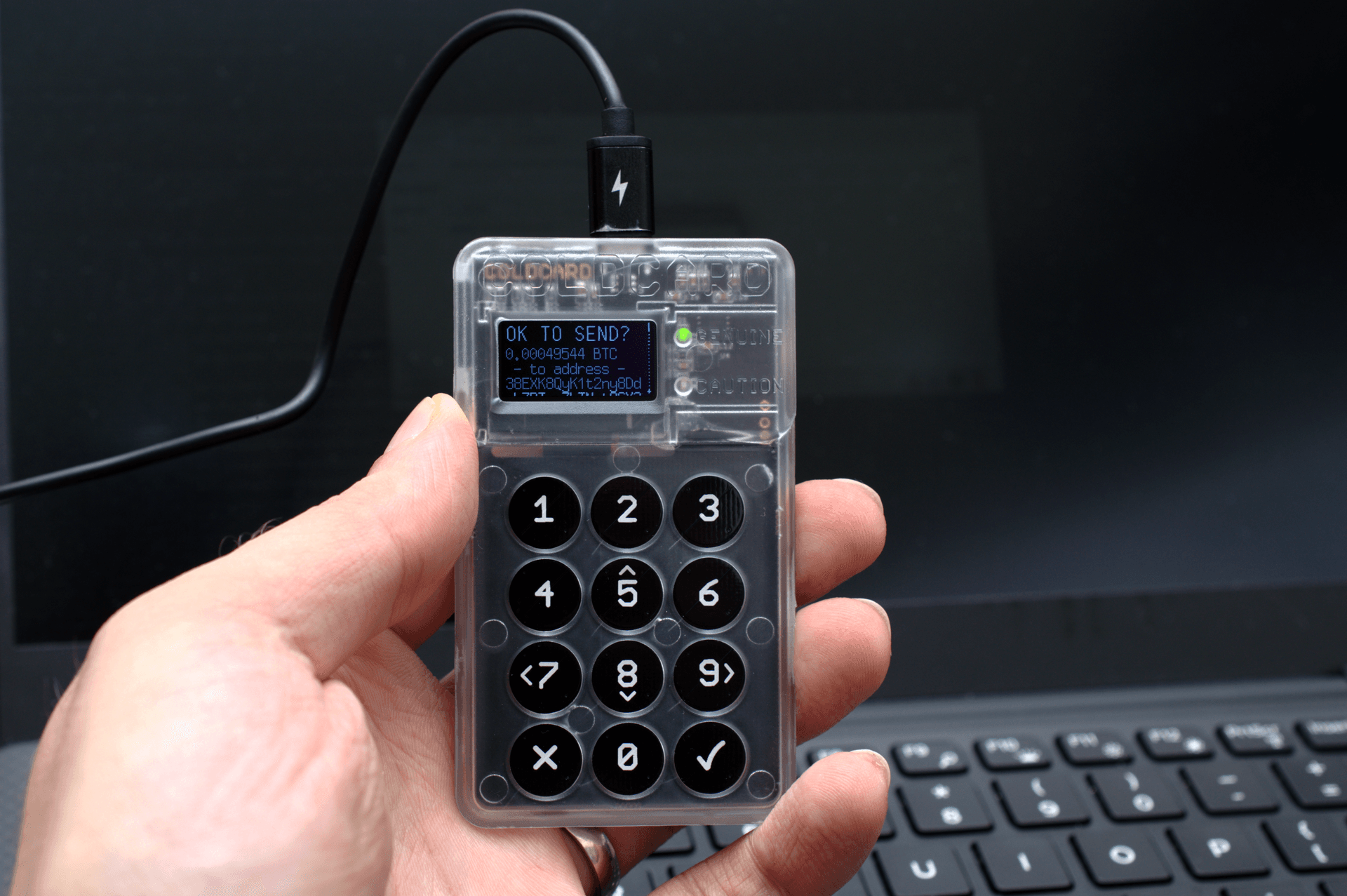
A hardware wallet is not a vault that stores cryptocurrency. It is a transaction-authorisation system that tries to keep private keys outside the ordinary computer or phone used to construct and broadcast transactions.
The assets remain on their blockchains. What the device protects is the authority to move them.
That distinction changes the security question. The useful question is not simply “Is a hardware wallet safe?” It is: which failure does the signer remove, which failure does it merely make harder, and which failures remain outside the device entirely?
The useful model: host, signer and recovery
A hardware-wallet setup has at least three security domains.
- The host is the internet-connected phone or computer that reads blockchain data, constructs transactions and broadcasts them.
- The signer holds or derives the private key and creates signatures after an approval step.
- The recovery system recreates the wallet if the signer is lost, destroyed or replaced.
The main benefit of a hardware wallet is separation. Compromising the host should not automatically reveal the private key. But the host can still propose a dishonest transaction, and the recovery system can still become a separate path to total loss.
What the hardware actually changes
| Failure | What a hardware wallet can change | Residual risk |
|---|---|---|
| Remote key theft | Keeps the signing key outside ordinary connected software | Malware can still manipulate transaction data or the interface |
| Wrong transaction | Can provide an independent approval display | The owner can still approve the wrong address or contract action |
| Device theft | PINs and hardened hardware can raise attacker cost | Physical resistance varies by design and attacker capability |
| Device loss | Makes the physical signer replaceable when recovery works | A missing or incorrect backup can turn device loss into permanent loss |
| Recovery-secret theft | Usually does not help once the complete recovery secret is compromised | An attacker may reconstruct the wallet elsewhere |
| Token or issuer control | No direct change | Pause, blocklist, upgrade, bridge and protocol powers still apply |
| Inheritance failure | No automatic solution | A secure wallet can still become inaccessible to intended heirs |
This is why “hardware wallet = safe” is too broad. The device is strong at one specific job: reducing direct exposure of signing authority to a general-purpose host.
How isolated signing works
- The wallet application reads public blockchain data and constructs an unsigned transaction.
- The transaction data moves to the hardware signer through USB, Bluetooth, NFC, QR code or another transport.
- The signer parses the request and displays whatever destination, amount and transaction details it can independently verify.
- The owner approves or rejects the request on the trusted device.
- The signer creates the cryptographic signature using the private key.
- The signed transaction returns to the online host for broadcast.
The private key does not need to travel with the transaction.
Bitcoin’s BIP-174 Partially Signed Bitcoin Transaction format formalises this separation for Bitcoin workflows. It explicitly supports offline signers by carrying the transaction information a signer needs without requiring direct access to the live UTXO set.
The trusted display is part of the security boundary
Key isolation and transaction verification solve different problems.
A compromised laptop may be unable to extract the private key but still be able to replace a destination address, construct an unwanted token approval or present misleading transaction data. If the owner confirms the same manipulated information without checking an independent display, the key can remain perfectly protected while the transaction itself is disastrous.
This makes the signer’s display—and the owner’s habit of reading it—part of the security design. A secure element can protect a secret. It cannot decide whether the economic action you are approving is sensible.
For high-risk dApp activity, an additional control is often more valuable than another hardware feature: separate long-term savings from the wallet used for routine contract interactions.
Hardware wallet, cold wallet and exchange are different layers
A hardware wallet is a device category. A cold wallet describes a custody condition in which signing keys remain offline or isolated from ordinary internet-connected systems. A centralised exchange account is different again: the platform controls the withdrawal infrastructure and the user holds an account claim rather than direct signing authority.
A hardware signer can be used as cold storage, but buying hardware does not automatically create conservative cold storage. A signer used every day with unfamiliar contracts may isolate its key while functioning operationally like a high-exposure wallet.
Likewise, withdrawing from an exchange removes one counterparty dependency but replaces it with personal recovery, signing and backup responsibilities.
For the broader architecture, see Hot Wallet vs Cold Wallet and Hardware Wallet Threat Model Matrix.
Recovery is the durable control
The hardware device is normally replaceable. The recovery material is what allows the signing authority to survive loss of the device.
Many wallets derive keys from deterministic seed material. BIP-32 defines hierarchical deterministic wallets, while BIP-39 describes the widely used mnemonic-to-seed process and optional passphrase construction.
This creates a fundamental custody trade-off: the backup must be recoverable enough to survive device loss, but protected enough that discovery does not become a theft path.
A hardware wallet therefore has two opposite failure modes:
- too little recovery: the owner loses the signer and cannot reconstruct the wallet;
- too much exposed recovery: an attacker obtains the material needed to reconstruct it elsewhere.
The objective is not maximum complexity. It is a recovery design that survives the failures you actually care about and can still be executed under stress.
A passphrase changes the wallet, not merely access to it
A BIP-39 passphrase is often misunderstood as a password layered over the same wallet. In the BIP-39 construction, the passphrase participates in deriving the seed. A different passphrase can therefore produce a different valid wallet.
This can reduce the damage from recovery-word exposure in some threat models, but it also creates a self-lockout risk: a forgotten or mistyped passphrase may restore a valid wallet that is not the wallet holding the intended funds.
Use Seed Phrase vs Passphrase before adding a passphrase simply because it sounds like “more security.”
Device features matter only through a failure model
USB, Bluetooth, NFC and QR workflows are not security rankings by themselves. They are transport choices. Secure elements, open firmware, larger displays, air gaps and Bitcoin-only firmware can all change particular attack surfaces, but none eliminates the need to identify the dominant failure first.
Before comparing devices, answer four questions:
- What am I protecting? Define the assets, networks and economic consequence of loss.
- What is the dominant failure? Remote malware, malicious approvals, physical theft, backup exposure, recovery loss and inheritance require different controls.
- What must I verify before signing? The display and transaction parser must support the actions you expect to approve.
- How will recovery work without this device? The answer should be documented and tested before the balance becomes important.
Only after those questions does a product comparison become useful. Our Best Hardware Wallets guide compares current devices by threat model rather than feature count alone.
A safer operating pattern
A hardware wallet works best as one component in a broader custody architecture.
- Acquire the signer through a trusted distribution route and initialise it yourself.
- Create or import the recovery material only in a deliberately controlled environment.
- Keep recovery material offline and separate from ordinary cloud accounts and messaging systems.
- Verify a receiving address on the trusted device before sending meaningful value.
- Perform a small outgoing transaction before relying on the setup for a large balance.
- Test recovery without exposing the real secret to an untrusted device or website.
- Keep routine dApp activity and experimental approvals away from the long-term savings wallet.
- Document enough of the recovery process that the system does not depend entirely on memory.
The setup sequence is covered in more detail in How to Set Up a Hardware Wallet.
When a hardware wallet is worth the operational burden
There is no universal balance at which a hardware wallet becomes mandatory. The decision is better framed by consequence.
The case becomes stronger when losing the holdings would materially affect your finances, when the assets are intended to remain untouched for long periods, when exchange dependence is unacceptable, and when you are willing to maintain a tested recovery process.
For a very small operational balance, extra custody complexity can create more mistakes than it prevents. For meaningful long-term holdings, separating signing authority from everyday connected software is usually a substantial improvement—provided the recovery system is at least as carefully designed as the device.
The decision test
A hardware-wallet setup is doing useful security work when all four statements are true:
- The ordinary phone or computer cannot directly obtain the private key.
- The owner can independently verify the transaction intent before signing.
- Loss of the physical device does not imply loss of the assets.
- Loss or compromise of one non-critical component does not silently become total loss.
If one of those statements is false, the next improvement is usually not another feature. It is a better boundary, a better verification habit or a better recovery design.
The hardware is replaceable. The signing authority is not. Judge the system by how well it protects, verifies and recovers that authority.
Primary sources
- BIP-32: Hierarchical Deterministic Wallets
- BIP-39: Mnemonic code for generating deterministic keys
- BIP-174: Partially Signed Bitcoin Transaction Format
No affiliate link is used in this article.