

OneKey Classic 1S is not the obvious winner of any hardware-wallet category.
Its screen is smaller than premium touch devices. Its product surface is broader than a minimalist Bitcoin signer. Its standard model carries a battery that a long-term vault does not strictly need.
That sounds like a criticism. It is also the product’s case.
Classic 1S is a compromise device in the useful sense of the word: an independent screen, open firmware, USB-C, Bluetooth and a Bitcoin-only path at a price below the premium touchscreen tier. The buying decision is whether those compromises line up with the job you actually need the signer to do.
Affiliate disclosure: This review contains a tracked OneKey link. Cryptophia Research may earn a commission from a qualifying purchase at no extra cost to you. The conclusion is based on the trade-offs below. See our Affiliate Disclosure and How We Research.
Evidence boundary: this review is based on OneKey’s current product documentation, public firmware repository and release materials. It does not claim long-term hands-on product testing.
The reason to buy Classic 1S is balance, not a headline feature
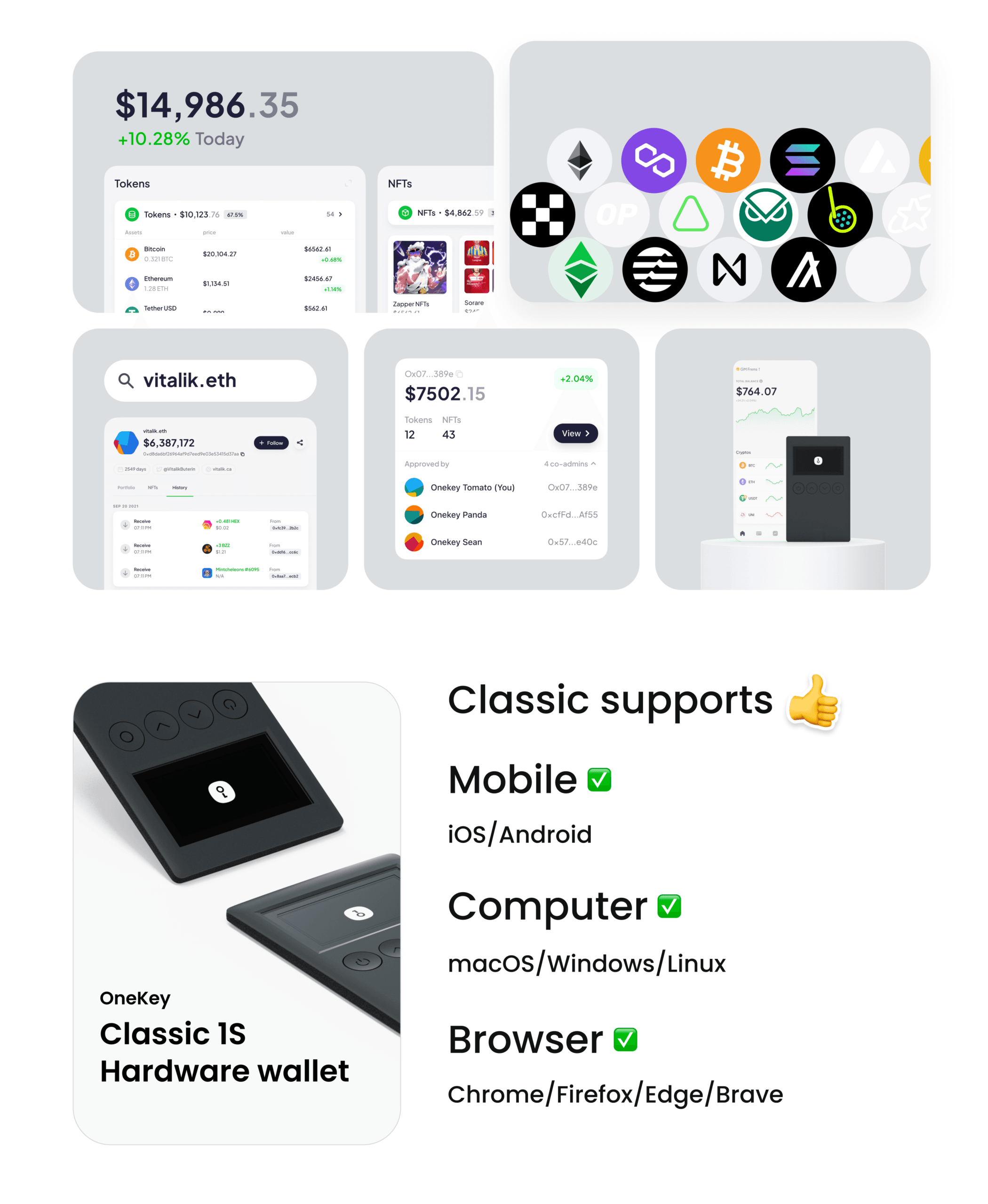
The standard Classic 1S combines a 1.54-inch 128 × 64 monochrome display, USB-C, Bluetooth, an EAL6+ secure element, open firmware and support for both broad multi-chain use and a Bitcoin-only firmware path.
Those features pull in different directions.
Bluetooth and a battery make mobile signing easier. Bitcoin-only firmware can narrow the active signing surface. Open code makes software changes more inspectable. The physical display gives the owner a place outside the phone or computer to review a transaction.
But every advantage has a ceiling. The screen is independent but small. The firmware is open but still part of a larger hardware and software chain. Multi-chain support is flexible but creates more transaction formats to parse. The battery is convenient but becomes a maintenance component if the device spends years in storage.
The 128 × 64 screen sets the product’s ceiling
A trusted display does not have to be large to be useful. It does have to carry enough information for the owner to understand what is being authorised.
For a straightforward send, a small display can still provide an independent checkpoint for amount, address and device prompts. As transaction complexity rises, the constraint becomes more visible: longer addresses, structured smart-contract actions and multi-step interactions are harder to review comfortably on a 128 × 64 screen.
OneKey’s Clear Signing and SignGuard work aims to improve human-readable context where supported. That is useful, but the physical display still determines how much of that context can be consumed without depending heavily on the companion app.
This is the product’s main limit for me. Classic 1S makes more sense as a deliberate signer for understandable transactions than as the device I would choose specifically for frequent complex contract review.
The battery question splits the product family in two
OneKey now sells both the standard Classic 1S with a built-in battery and Classic 1S Pure variants without one.
That changes the decision more than the model names suggest.
The battery model makes sense when Bluetooth and regular mobile use are part of the job. A device that is actually used every week benefits from not needing a cable every time it signs.
The Pure version is more coherent for a signer expected to sit in storage for long periods. Removing the battery does not make the wallet cryptographically safer by itself; it removes one ageing component and one maintenance obligation from the storage problem.
So the choice is not “battery bad, battery-free good.” It is operational wallet versus stored signer.
Open firmware improves auditability, not certainty
OneKey publishes the Classic 1S firmware in a public repository and documents release and verification processes. That matters because security claims can be checked against visible code and changes can be reviewed over time.
It does not turn the whole device into a proof.
The owner still depends on the secure element, board implementation, build and signing process, Bluetooth component, OneKey App, transaction parsers and the quality of each integration. Public code narrows one trust boundary; it does not erase all of them.
The 2026 firmware history is useful evidence here. Releases added or improved features such as Bitcoin-only switching and Ethereum transaction handling while also fixing defects. That is what maintained security software looks like: active maintenance is positive, and the need for maintenance is itself evidence that broad signing software keeps evolving.
Bitcoin-only mode is only valuable if the wallet really has one job
Classic 1S can run a Bitcoin-only firmware path, and OneKey sells a battery-free BTC-only Pure variant.
The security argument is straightforward: if the owner will never sign Ethereum, Solana or other transactions, removing unrelated parsers and flows can narrow the active software surface.
The operational counterargument is just as important. A person who actually holds and uses several networks may create more mistakes by forcing a Bitcoin-only device into a portfolio that then requires several additional wallets and recovery systems.
Use the narrow firmware because the job is narrow, not because minimalism sounds virtuous. The wider trade-off is covered in Bitcoin-Only vs Multi-Coin Hardware Wallets.
Bluetooth is worth judging as workflow, not ideology
Bluetooth does not move the private key into the phone. It creates another communication path between the signer and host.
If mobile use is central, that path is part of why the product exists. If the wallet is rarely used and USB-C is convenient enough, the wireless component may add little value.
The decision therefore depends on frequency. A feature that reduces friction every week can improve real security by making the intended process more likely to be followed. The same feature on a device that spends two years in a safe may simply be another component to maintain.
The buyer I think Classic 1S makes sense for
I would put Classic 1S on the shortlist for someone who wants an independent hardware display, prefers inspectable firmware, actually benefits from mobile connectivity and does not want to pay for a premium touchscreen.
I would look elsewhere when the main job is frequent complex contract signing, camera-based air-gap workflows, or an extremely narrow long-term Bitcoin vault where a battery-free focused signer is the design goal from the start.
The most interesting alternative may actually be inside OneKey’s own product family: if Bluetooth mobility is not important, the battery-free Pure variant removes a trade-off without changing the basic signing philosophy.
What would make me change this view?
A larger independently secured display at the same product tier would strengthen the case for complex signing. A material change in the open-build or firmware-verification process would change the trust assessment. A serious unresolved hardware, firmware or Bluetooth vulnerability would move the recommendation the other way.
Absent that, Classic 1S remains a balanced mid-range signer rather than a category champion—and that is a perfectly defensible reason to buy it.
For a broader shortlist, compare Best Hardware Wallets and Best Hardware Wallets for Beginners.
Check current OneKey Classic 1S models and availability →